
Vacation check list – Keep your house, Pack every you need , Be Ready for holiday
Print this page to use as a Vacation check list to make sure you've got everything before you head for the departure lounge.

Travel with absolute peace of mind with Lets Tour Bangkok.
The Ultimate Pre-Vacation Checklist: Secure Your Home, Pack Smart, and Be Ready for Thailand 🧳✈️
The countdown to your dream holiday in Thailand is one of the most exhilarating experiences imaginable. Whether you are eagerly anticipating street food crawls through Bangkok’s neon-drenched night markets, tranquil dawn temple meditations in Chiang Mai, or island-hopping across the turquoise Andaman Sea, thorough pre-departure preparation is the absolute key to a stress-free adventure. Nothing ruins a tropical getaway faster than arriving at your destination only to wonder nervously if you forgot to turn off the main water valve at home, left vital prescription medications behind, or packed clothes that violate sacred temple dress codes.
To ensure your holiday unfolds smoothly from the moment you lock your front door to the day you touch down back home, we have engineered this definitive master vacation checklist. Divided into five comprehensive preparation phases—Home Security & Automation, Tropical Climate Packing, Health & Medical Essentials, Digital & Financial Readiness, and Aviation Baggage Compliance—this guide guarantees complete peace of mind. For transit logistics upon landing, don't miss our comprehensive Don Mueang Airport (DMK) Survival Guide and learn how to capture professional memories with our Vacation Photography Tips Guide.
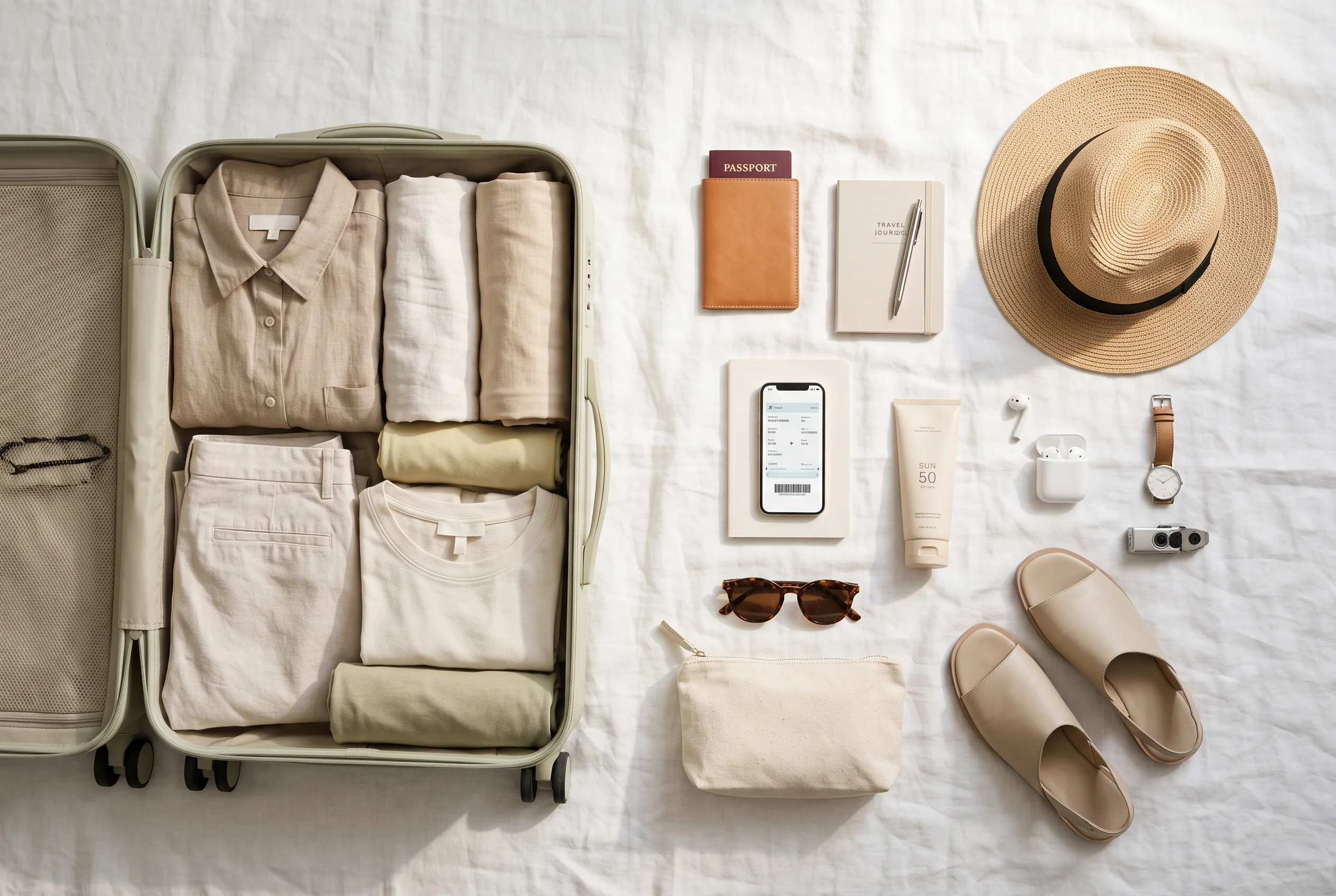
📋 Master Checklist Golden Rules: (1) Shut off your home's main water supply to eliminate the #1 cause of household disaster while traveling. (2) Strictly obey Thai temple dress codes by packing lightweight linen pants and sleeved shirts. (3) Carry all power banks and lithium batteries strictly in your carry-on luggage (never checked baggage). (4) Ensure your passport has at least 6 months of remaining validity from your date of entry. (5) Configure offline two-factor authentication (2FA) before swapping SIM cards.
Phase 1: Securing Your Home Before Departure
A truly relaxing vacation begins with the certainty that your home is secure, safe, and protected against utility disasters while you are away:
1. Plumbing and Water Disaster Prevention
Plumbing leaks and burst washing machine hoses are statistically the single most common cause of catastrophic home damage during extended holidays. Always turn off the main water shut-off valve to your entire house or apartment before heading to the airport. In addition, turn off individual isolation valves behind washing machines and toilets, turn off the circuit breaker to your domestic hot water heater to prevent dry-tank heating element burnout, and drain residual pressure by briefly opening an outdoor garden spigot.
2. Electrical Safety and Vampire Power Elimination
Unplug all non-essential consumer electronics, including desktop computers, televisions, gaming consoles, coffee makers, microwaves, and secondary chargers. This completely eliminates "vampire power" electrical draw—saving you money on utility bills—and protects your valuable equipment from power surges during sudden summer lightning storms.
If you live in a humid climate, set your smart thermostat to a moderate vacation / dehumidifier mode (around 28°C / 82°F) rather than turning the AC off completely, preventing mold and mildew accumulation while you are traveling.
3. Home Automation and Smart Security
- Smart Lighting Timers: Set digital timer plugs or smart light bulbs (such as Philips Hue) to turn on and off in living rooms and bedrooms at natural intervals in the evening, creating the realistic illusion that the home is occupied.
- Perishable Food Disposal: Empty your refrigerator of milk, fresh meat, berries, and vegetables that will expire during your absence; clean the kitchen sink and run the garbage disposal to prevent mold and foul odors.
- Trash Removal: Empty every wastebasket in the house and take bins to outdoor curbside containers so decomposing food does not attract insects or rodents.
- Lock Down Points of Entry: Double-check all ground-floor window latches, sliding patio door security bars, garage deadbolts, and pet doors. Notify a trusted neighbor or family member of your travel dates and leave an emergency spare key.
Phase 2: Packing Smart for Thailand's Climate & Culture
Thailand's tropical climate is hot and humid year-round, with average daytime temperatures ranging between 30°C and 36°C (86°F – 97°F). Packing bulky synthetic clothes will result in misery. Focus on lightweight, breathable, and culturally respectful apparel:
1. Clothing Fabrics and Compression Strategies
- Breathable Natural Fabrics: Pack 100% pure linen, ultra-lightweight cotton, or moisture-wicking technical athletic fabrics. Avoid heavy denim or thick polyester that trap sweat. Use compression packing cubes to organize your shirts, shorts, and underwear, saving up to 40% of suitcase volume.
- Temple-Appropriate Attire: When entering sacred Buddhist temples (such as the Grand Palace, Wat Phra Kaew, Wat Pho, and Wat Arun), strict dress codes are enforced. You must pack lightweight long trousers, linen maxi dresses, or elephant pants that cover the knees, as well as tops that fully cover the shoulders and upper arms (no tank tops, crop tops, or see-through shirts).
- Footwear Strategy: Bring one pair of ultra-cushioned walking sneakers for extensive sightseeing, and one pair of high-quality slip-on sandals or loafers. Because shoes must be removed before entering every Buddhist temple hall and many traditional massage shops, slip-on shoes save enormous time and hassle.
- Tropical Rain Protection: Sudden monsoon downpours can occur within minutes. Pack a compact windproof travel umbrella with UPF sun-blocking coating, or a lightweight packable rain poncho.
2. Sun and Heat Defense
The tropical UV index in Thailand frequently reaches extreme levels (11+). Protect your skin and eyes with broad-spectrum SPF 50+ water-resistant sunscreen (reef-safe formulas containing zinc oxide or titanium dioxide are mandatory when visiting Thai national marine parks in Krabi and Phuket), polarized sunglasses with UV400 protection, and a breathable wide-brim sun hat.
Phase 3: The Traveler's Medical & Health Kit
While Thailand boasts world-class international hospitals and pharmacies on nearly every street corner, having an immediate personal medical kit in your daypack prevents minor discomforts from derailing your itinerary:
💊 Essential Travel Medical Kit Contents:
- Oral Rehydration Salts (ORS): Packets of Royal-D electrolyte powder to rapidly recover from dehydration, heat exhaustion, or traveler's diarrhea.
- Gastrointestinal Defense: Loperamide (Imodium) for diarrhea control, activated charcoal capsules (Carbomec) to absorb mild toxins, and antacids for spicy food heartburn.
- Pain and Fever Relievers: Paracetamol/acetaminophen for headaches or tropical fevers. (Note: Avoid aspirin or ibuprofen if dengue fever is suspected, as NSAIDs can increase bleeding risk).
- Insect Repellent: Sprays containing 20% to 30% DEET or Picaridin to guard against dengue-transmitting Aedes mosquitoes, especially around dawn and dusk.
- Blister Bandages & Antiseptic: Hydrocolloid blister cushions and antiseptic wipes for feet walking 15,000+ steps daily across temple grounds and street markets.
- Personal Prescription Meds: Carry all prescription medications in their original pharmacy packaging with prescription labels attached, accompanied by an official doctor's travel letter.
Phase 4: Digital, Financial, and Document Readiness
Administrative and digital preparation prevents nightmare scenarios at immigration checkpoints and airline gates:
| Document / Financial Item | Requirement / Action | Critical Detail |
|---|---|---|
| Passport Validity | Strict 6-month rule | Airlines will deny boarding if your passport expires in under 6 months. |
| Comprehensive Travel Insurance | $50,000+ medical & evacuation cover | Covers hospital stays, motorcycle accidents, and emergency medical flights. |
| Credit & Debit Cards | Notify bank of travel to Thailand | Carry two separate cards; Thai ATMs charge a standard 220 THB foreign fee. |
| 2FA & Offline Authentication | Set up app-based authenticator (Google/MS) | Prevents being locked out of banking apps when your home SMS number is inactive. |
| Connectivity & eSIM | Download eSIM or buy AIS/True at airport | Essential for calling Grab/Bolt ride-hailing cars and Google Maps navigation. |
| Power Bank Regulations | Carry-on bag ONLY (Max 20,000–32,000 mAh) | Power banks are strictly forbidden in checked luggage by airport security. |
Phase 5: Airline Baggage Compliance & Domestic Flights in Thailand
When traveling internally across Thailand on domestic budget carriers—such as AirAsia, Nok Air, Thai Lion Air, or VietJet—aviation luggage rules are strictly enforced at departure gates:
- The 7kg Cabin Baggage Limit: Budget airlines rigorously weigh carry-on luggage at gate check-in. Exceeding the 7kg limit results in hefty airport baggage surcharges (often 1,000 to 1,500 THB per bag). Pre-book checked baggage online during flight reservation to save up to 60%.
- Liquid Rule (100ml): All liquids, gels, creams, and aerosols in carry-on bags must be in individual containers not exceeding 100ml (3.4 oz), enclosed within a single transparent resealable 1-liter plastic bag.
- Lithium Battery Watt-Hour Calculation: Airline security inspects power banks before boarding. The formula is:
Watt-hours (Wh) = (mAh / 1000) × 3.7V. A 20,000 mAh power bank equals 74 Wh, which is well within the 100 Wh airline safety limit and permitted without prior airline approval.
Frequently Asked Questions (FAQ) About Vacation Planning for Thailand
คำถามที่พบบ่อยและข้อมูลสำคัญที่คุณควรรู้ รวบรวมโดยผู้เชี่ยวชาญท้องถิ่น
Q1 How many months of passport validity do I need to enter Thailand?
You must have at least six (6) months of remaining passport validity from your planned date of entry into Thailand. International airlines will refuse boarding if your passport has less than six months remaining, even by a single day.
Q2 Why should I shut off my house's main water valve before traveling?
Plumbing leaks and ruptured washing machine hoses are the leading cause of catastrophic home damage while homeowners are away. Shutting off the main valve ensures that even if an internal pipe bursts, water damage will be completely avoided.
Q3 What is the strict dress code for visiting temples in Thailand?
Both men and women must have their shoulders and knees completely covered. Sleeveless shirts, tank tops, crop tops, short shorts, mini skirts, and transparent fabrics are strictly prohibited. Wear lightweight linen trousers or maxi skirts and sleeved shirts.
Q4 Can I pack power banks in my checked baggage for flights to Thailand?
No. International and Thai domestic aviation security regulations strictly prohibit spare lithium-ion batteries and power banks in checked baggage due to fire risks. Power banks must be kept in your carry-on bag and must clearly display their capacity rating (under 20,000 mAh is freely allowed; between 20,000 and 32,000 mAh requires airline permission).
Q5 What power plug adapter do I need in Thailand?
Thailand uses electrical sockets that accept Type A, Type B, Type C, and Type O plugs operating at 220V and 50Hz. Most two-prong flat US plugs and two-prong round European plugs fit directly into Thai wall outlets without an adapter. A universal adapter is recommended for 3-prong UK or Australian plugs.
Q6 How much cash should I carry when arriving in Thailand?
While credit cards are widely accepted at hotels and malls, cash in Thai Baht (THB) is essential for street food, local taxis, tuk-tuks, and night markets. Carrying 5,000 to 10,000 THB in cash per person upon arrival provides a comfortable buffer.
Q7 Is tap water safe to drink in Thailand?
No. Tap water in Thailand is not potable for drinking. Always drink bottled purified water, sealed mineral water, or water from hotel filtration carafes. Ice served in restaurants and street stalls is manufactured in commercial ice factories from purified water and is safe to consume.
Q8 Should I buy an eSIM or a physical SIM card at the airport?
Both work wonderfully. If your phone supports eSIM, you can purchase an unlimited data plan online (such as Airalo or Nomad) before flying. Alternatively, official kiosks for AIS, TrueMove H, and DTAC in the airport arrivals hall offer 7, 15, and 30-day tourist physical SIMs installed in minutes.
Q9 What ride-hailing apps work best in Thailand?
Grab and Bolt are the two leading ride-hailing applications across Bangkok, Chiang Mai, and Phuket. Download both apps before departure and link your credit card so you can order metered cars without language barriers or fare negotiations.
Q10 What should I pack for sudden tropical rain showers?
Carry a compact UV/rain umbrella or a packable lightweight rain poncho in your daypack. Heavy waterproof rain jackets often trap body heat and become uncomfortably humid in tropical temperatures.
Q11 Do I need travel medical insurance for Thailand?
Yes. Comprehensive travel medical insurance is strongly advised. While high-quality private healthcare in Thailand (such as Bumrungrad or Bangkok Hospital) is affordable compared to Western countries, serious motorcycle injuries or emergency surgeries can cost tens of thousands of dollars without insurance coverage.
Q12 What shoes are best for traveling in Thailand?
Comfortable slip-on walking shoes, breathable sneakers, or supportive sandals with heel straps (such as Teva or Birkenstock EVA). Because you will remove your shoes multiple times a day when visiting temples, massage parlors, and private homes, slip-on shoes save considerable effort.
Recent Stories


Book a Tour in Thailand
Experience Bangkok, Chiang Mai, and Phuket with our licensed private tour guides.
Browse Tours
Subscribe Our Newsletter
Subscribe our newsletter to get offers and about new places to discover.